How Long Should It Take to Wean Baby Piglets
Originally published as PIH-18.
Authors: Duane E. Reese, University of Nebraska Thomas G. Hartsock, University of Maryland; W. East. Morgan Morrow, North Carolina Country Academy
Reviewers: Duane Miksch, Academy of Kentucky; Tilford R. Cline, Purdue University
Practiced care and management in the farrowing quarters has a major influence on the number of liveborn piglets that are weaned and on how well they perform in later stages of product. According to a 1995 survey of swine management practices in the United States, the average number of preweaning piglet deaths per litter on farms was .88 or 9.4% of those born alive. The two leading causes of preweaning deaths were laid on (48.7%) and starvation (xx.5%). Other surveys accept shown that over 50% of the deaths occur in the kickoff 2 to three days of life.
A successful caretaker understands that newborn piglets have certain concrete characteristics which make them very reliant on proper direction and care. Piglets are built-in without any antibiotic protection, their bodies incorporate fat free energy for about i solar day of life, and they cannot regulate internal body temperature well until they are a few days one-time. Thus, anything that may atomic number 82 to a reduction in milk production or consumption, such every bit spooky or exposure to disease organisms, compromises the health and well-being of newborn piglets.
Piglets built-in alive autumn into two broad categories—normal and disadvantaged. It is of import to recognize the deviation between normal and disadvantaged piglets so appropriate help can be provided. Normal piglets will be born quickly, go on their anxiety within a infinitesimal or 2 and be suckling in almost 15 minutes. They movement from teat to teat, taking a disproportionately large share of the most full-bodied, immunoglobulin-rich colostrum. If the sow is a skillful mother and the farrowing environment is adequate, normal piglets thrive without much help from the flagman.
Disadvantaged piglets are ones weakened by the rigors of the birth process, are lightweight, have a congenital defect(south), are slow reaching the udder, or are chilled. Piglets weakened during the nascency process include those that were oxygendeprived but not killed, "apparent" stillbirths that were revived, and piglets experiencing excessive concrete trauma. The longer a sow takes to farrow the greater the chance these problems will announced. Lightweight piglets, especially those weighing less than 2.75lb at birth, are much less likely to survive to weaning than heavier piglets. Splayleg is a common congenital defect observed in disadvantaged piglets. Disadvantaged piglets are as well slow in getting on their anxiety and to the udder. Their weakened land compromises their power to compete with stronger, normal litter mates for access to teats during the outset hours later on nativity. This reduces their intake of colostrum. Chilled piglets often feel a lower core trunk temperature which makes them susceptible to death. Often these piglets are seen shivering and huddled with litter mates, considering their thermal requirements accept not been met. This fact sheet describes management practices that should increase the number of piglets weaned equally well as their ability to perform well in subsequent stages of product. Some of these practices are meant for all piglets in the litter, whereas others are mainly for disadvantaged piglets. There is a general fourth dimension frame in which it is nearly desirable to perform many of these techniques.
Attended Farrowings
Research indicates that attending and assisting at farrowing tin increment piglet survival and the number of pigs weaned. Past beingness present at farrowing, one tin can quickly identify disadvantaged piglets and brainstorm to assist them. Even so, each producer should counterbalance carefully the costs and benefits of supervised farrowings. Having many litters to supervise at one time (through batch farrowing or continuous farrowing in a multiple farrowing room complex) makes more efficient use of labor.
Prevent Chilling
The farrowing quarters need to provide two different microclimates: a cool 1 for the sow (60-65°F) and a hot ane for the newborn piglets (85-95°F the first few days, then decreased to the seventy-80°F range). To achieve this goal, maintain a room temperature at approximately 65-70°F and provide zone heating for the litter.
Closely monitor the sow and litter's responses to the zone heating to ensure their thermal needs are met. If the amount of estrus provided by the zone heaters is excessive, piglets volition move away from the rut source. This not simply wastes ability but can crusade the sow to become as well warm and increase piglet mortality. The thermal needs of piglets are met if they are lying in a decumbent position gently touching each other. If they are piled, attention should be given to providing more rut.
Provide zone heating in the farrowing quarters outset 24 hours before expected farrowing. Rut lamps, heat pads, radiant heat devices, and hovers are mutual ways to provide zone heating in farrowing houses. Many times, even so, the zone heating is placed only to the side of the sow in the pitter-patter area. Research indicates that having an additional heat lamp placed at the rear of the sow during farrowing reduces piglet mortality. The extra heat source assures the piglet of immediate warmth following birth. The key is to have the supplemental rut directed behind the sow before farrowing and until farrowing is completed. If there is no extra heat nowadays backside the sow during farrowing, position disadvantaged piglets in a heated surface area immediately afterwards nativity.
Colostrum Intake
The showtime milk, colostrum, is rich in affliction-preventing immunogloblins; the very get-go colostrum is the richest and best, considering the quality of colostrum declines over fourth dimension. Getting a skilful dose of colostrum, particularly from the piglet'southward dam, is probably the single most important factor related to a piglet's survival and long-term health. Strong, early on-born piglets get to the udder hours before their later-born litter mates and go from teat to teat taking the best colostrum. Thus, disadvantaged piglets ofttimes need assistance to obtain enough colostrum. Below are some methods to ensure piglets obtain an adequate dose of colostrum.
- Forestall spooky so piglets stay warm and active.
- Divide suckle. This involves removing role of the litter for one to ii 60 minutes periods the first 12 hours afterwards farrowing. For best results, remove the largest, strongest piglets for a one to ii hour period during the morning and once more in the afternoon, leaving the small piglets on the sow to nurse. Give the sow 20-30 U.S.P. units of oxytocin (ane to 1.5ml) each fourth dimension the largest piglets are removed. Be sure to agree the large piglets in a box fitted with supplemental heat to prevent chilling. Employ this technique to ensure high colostrum intake earlier crossfostering.
- Collect colostrum from the sow or obtain cow colostrum and give it to piglets via a tum tube or a syringe. To milk a sow, remover all her piglets for 1 hour. Then give her xx-30 U.S.P. units or one to 1.5ml of oxytocin, wait one or ii minutes, then strip her teats (front teats are better exist cause they produce more than milk) to obtain colostrum. Moo-cow colostrum as well tin can be used and may more easily obtained. Either type of colostrum tin exist frozen in ice cube trays for hereafter employ. How ever, practise not thaw the cubes in a microwave oven, because rapid thawing reduces the immunological value of the colostrum. Tummy tubes can exist made from model plane fuel tubing or past using a urinary catheter (size xiv French) available from medical supply stores. Attach the tube to a syringe and lubricate the tube with vegetable oil or KY jelly before inserting it 6-seven inches into the piglet'southward stomach. Give the piglet x-15ml of colostrum one time or twice during the first 24 hours of life.
Crossfostering
The lowest piglet bloodshed is observed in high birthweight litters with low within-litter piglet weight variation. Crossfostering is the most effective style to reduce within-litter piglet weight variation. The primary purposes of crossfostering is to reduce the weight variation within the litter and to more evenly match the number of piglets with the sow'south ability to enhance them (determined by the number of functional teats).
Crossfostering should exist proficient carefully to achieve best results. A good crossfostering programme makes milk supplies more available to all piglets and does not compromise the health status of the piglets in segregated early on weaning (Stitch) programs. Below are important tips to ensure good results from crossfostering.
- Ensure piglets that will be crossfostered consume colostrum from their dam. Allow piglets to remain with their dam for at to the lowest degree four to six hours post-obit nascence earlier they are crossfostered. Otherwise, it is likely the fostered piglets will not consume an adequate amount of colostrum, peculiarly if they are fostered to a sow which farrowed one to two days previously.
- Crossfoster piglets earlier they are 24 to 48 hours old. Piglets establish teat fidelity (preference for a teat) inside the starting time days after birth and will almost e'er suckle at the aforementioned teat or pair of teats until weaning. It is an reward for piglets to establish teat fidelity, because information technology reduces competition and fighting at the udder. When teat fidelity is not established, piglets fight more throughout lactation and have poorer weight gains. Crossfostering afterward teat fidelity is established is disruptive and induces fighting between resident and fostered piglets. An exception to this dominion is the fostering of i of a pair of piglets continuing to dispute a single teat location.
In SEW programs where maximum weaning age is important or in PRRS-positive herds, crossfostering piglets after they are 24-48 hours old places them at take chances of coming into contact with a nurse sow shedding pathogens against which the piglets received no colostral immunity. Therefore, illness may pass from the nurse sow to the piglets.
Some producers take successfully transferred older, small-scale piglets to nurse sows following early on weaning of the nurse sow's litter. In these instances, be sure the weaning historic period of the fostered piglets does not exceed the maximum weaning age set for the farm.
- Choose pocket-size, docile sows with minor, slender nipples of medium length to raise below- average-weight piglets.
- Discover for the presence of disease problems in the farrowing quarters before crossfostering. This is important to reduce the spread of disease. Avoid moving a good for you piglet to a diseased litter or vise-versa.
- Transfer males rather than females when replacement animals are retained from within the herd. Otherwise, accurateness of female selection may be reduced and gilts reared by foster dams take poorer reproductive functioning.
Processing Piglets
Processing piglets includes clipping teeth, clipping and treating the umbilical cord, iron administration, tail docking, identification, treating splaylegged piglets, providing supplemental nutrients, and castration. These skills tin be performed in different ways and in the sequence of personal preference. Some producers elect not to perform all these procedures, or they prefer to filibuster some of them for three to four days to reduce stress on the very fragile i-day-sometime piglet. Those who operate pasture farrowing systems tend to do all their processing of piglets during the beginning day after farrowing, considering the piglets are easier to grab. Producers recording mortality rates from birth to weaning in excess of 15% may consider delaying teeth clipping, tail docking, and castration of smaller piglets for a few days.
Equipment
Accept all the equipment you need to process piglets arranged in a hand-held carrier which can be attached to a pig cart preferably on wheels. Supplies and equipment needed to process piglets as described in this fact sheet are: disinfectant, such equally chlorhexadine (Nolvasan®) or quaternary ammonium compounds; antiseptic, such equally tamed iodine (U.Due south.P. 1 to two.v% solution), usually in a spray bottle; side cutters; supplemental iron; syringe with xviii to 20 gauge, ane/2 to 5/eight inch needles and a 14-16 guess 1 to 1 1/2 inch needle (optional); string or plastic clips for tying off umbilical cords; V-ear notcher or small animal tattoo pliers; adhesive, elastic or duct tape cut in i/2 to 3/four inch strips; castration knife or scalpel; shallow container for disinfectant in which to put the cutting edge of instruments betwixt uses.
Disease Transfer
While processing piglets, take steps to minimize transfer of disease. This can be done by processing ill litters final, cleaning and disinfecting the box or cart you use to transport piglets when you finish for the day or before you motility to another room to process, and dipping instruments into a disinfectant afterward y'all have processed each piglet. Be certain to change the disinfectant daily or later processing every tenth litter, whichever comes first.
Personal Safety

Be careful when removing piglets from the farrowing quarters. Sows often endeavor to bite or grab you to protect their litter. Ever accept the farrowing crate or another sturdy partition betwixt y'all and the sow before you attempt to pick up a piglet.
Holding the Piglet
Hold the piglet then you can cut the teeth, tail, and umbilical cord and administer iron in very rapid succession without changing your grip. For a right-handed person: place your left thumb into the pucker exist-hind the piglet's correct ear most midway from top to bottom. Maneuver your left index finger across the front of the piglet's face and into the corner of the left side of its mouth, behind the needle teeth. Your left pollex will terminate upward either behind the piglet's ears or in front of them depending upon the length of your fingers (Figure ane). Beware not to choke the piglet by pressing the remainder of your fingers into its throat. Use the fingers nether the jaw to support some of the piglet's weight. Dangle the piglet in front of you, and it will struggle less than if you pull it against you. You tin also sit and support its weight on your knees if necessary.
Umbilical String Intendance

The umbilical string, which enables the fetus to obtain nutrients from the dam and miscarry wastes during pregnancy, usually does not require much attention. While it is possible that bacteria and viruses can travel upwardly the cord after the piglet is born and crusade infection or that piglets tin drain excessively from it, these situations are rare.

If excess bleeding occurs from the umbilical cord, tie it off immediately with cord using a square or surgeon's knot (Figure two) or clamp information technology with a commercially available plastic prune. Seldom practise newborn piglets need to accept their umbilical cords tied or clamped. Sometimes newborn piglets bleed excessively immediately later on the umbilical cord breaks, specially if it breaks shorter than four to v inches. The loss of claret may cause the piglet to perform poorly or dice. The cause of the backlog bleeding could be due to a failure of the piglet's clotting mechanism.
If the string is not dried up only fresh at the time of processing, cut it off with disinfected side cutters. If the umbilical cord has been tied, yous tin leave about one inch. Leave three or four inches if the umbilical cord has not been tied; check for bleeding. Apply iodine antiseptic by swabbing, spraying, or dipping. The dip method requires placing the umbilical cord inside the clarified bottle and shaking gently. Any of these methods is satisfactory, just be sure to go good coverage of the umbilical cord. Employ disinfected side cutters and a fresh iodine solution (changed daily if dipping or swabbing, since iodine solutions break downwardly in the presence of organic thing). A contaminated iodine solution might really cause an infection.
If the string is dry and shriveled, it is not necessary to treat. Just cut it off, leaving ane to three inches of cord. (Effigy 3).
Needle Teeth Clipping

The newborn piglet has eight needle teeth, sometimes referred to every bit wolf teeth, located on the sides of the upper and lower jaws. Many producers clip these within 24 hours later on birth to reduce the chance piglets will lacerate each other and/or the sow'south udder. Some producers have stopped teeth clipping entirely while others do it as needed and they take not observed any serious problems. It seems less necessary to clip teeth of piglets nursing well-milking sows. All the same, in cases when sows are not milking well, or if greasy pig illness is a trouble, teeth clipping appears necessary for optimum results.
- Employ sharp cutters without nicks in the blades. Otherwise, teeth will be crushed, which could lead to infection. Also, replace side cutters that have jaws that practice not meet squarely. Avoid ordinary wire cutters every bit they oft are non made with the quality of steel necessary to cutting teeth adequately.
- Cut abroad half of the molar. Do not remove the entire tooth and avoid crushing or breaking it. Otherwise, an infection is possible or the piglet may not nurse well. Avoid cutting the piglet'south glue or natural language. This will likely go far difficult for the piglet to nurse.
- Cut the teeth off flat and not at an angle. Piglets are not equally apt to cause skin injuries when they fight if the teeth are cut off flat. Habiliment glasses or goggles to protect your eyes from flight pieces of teeth.
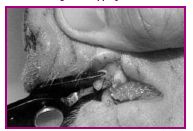
- Hold the piglet as described previously, and identify sterilized side cutters over both the lower needle teeth on i side of the mouth with the flat side of the cutter to the mucilage line. Identify the side cutters parallel to the mucilage, and cut off one-half of the ii lower teeth at one time (Figure 4). Plough the side cutters over and cutting the ii upper teeth (Figure 5). Repeat on the other side of the oral cavity.
Tail Docking

The undocked tail is a very convenient target for tail biting or cannibalism. This leads to injury and possibly infection. To reduce tail biting, dock (or cut off) the tail of newborn piglets inside almost 24 hours later on nascence. Tail docking is commonly required by purchasers of early weaned or feeder pigs. It should be done within about 24 hours subsequently birth because information technology is to the lowest degree stressful on the piglet for these reasons: the piglets are small and easy to hold; at this age, littermates are less likely to investigate and nip or seize with teeth a newly docked tail; the piglet and farrowing quarters are yet clean; and the piglet is well protected with antibodies from the colostrum of the sow. However, some producers delay docking the tails of male person piglets in the litter until castration. The males are easier to find in a litter if their tails accept non been docked.
Dock the tail about ane inch (or width of your thumb) from the place where the tail joins the body of the piglet (Figure 6). Cutting the tail too curt could interfere with muscle activity around the anus later in the piglet'southward life and could be an aggravating factor in rectal prolapse or rear leg paralysis. If too much tail is left, tail bitter might however occur. Occasionally, a tail will drain excessively. If this occurs, tie it off using the same method every bit for umbilical cords.
Use sterilized side cutters (most commonly used), a chicken debeaker, or a special heated cutter to cauterize the cutting tail. Do not use a very sharp instrument, such equally a scalpel, because excess bleeding may occur. To cauterize properly, cut the tail slowly so the hot blade has fourth dimension to cauterize the tail as you cut. Cauterizing leaves a cleaner wound that bleeds less than when side cutters are used. Use an antiseptic to the wound. The tail should be completely healed within seven-10 days.
Supplemental Iron
Iron is necessary to forbid anemia in piglets. Iron deficiency anemia develops chop-chop in nursing piglets because of low iron reserves in the newborn piglet, the depression fe in sow'south colostrum and milk, the lack of contact with iron in the soil, and the rapid growth rate of piglets. With no access to soil, iron deficiency anemia may event within 7-10 days after nascency.
Iron can exist administered either by injection or orally. Injection is preferred because fe given orally is not too absorbed by piglets, thus reducing the quantity of iron that reaches critical tissues. Oral fe as well may predispose some piglets to enteric disease (scour) bug, because iron is a necessary nutrient for the growth of microorganisms in the piglet's digestive tract. In addition, oral iron may not be captivated in piglets with diarrhea.
Administer iron to piglets while they are ane to three days old. Give piglets 200mg of atomic number 26 either equally 1 injection while they are ane to iii days onetime or in two-100 mg injections—i between one and three days of age and once more at weaning. Injectable iron products are bachelor in both the 100 and 200mg of fe/ml concentrations. Read the label carefully to acquire the atomic number 26 concentration of the product yous are using. Do not overdose, equally besides much iron can be toxic.

Using a clean syringe, withdraw fe solution from its container, using a 14 or sixteen estimate (big diameter) needle which is left inserted in bottle. The idea is to avoid using a contaminated needle to draw iron from the bottle. Otherwise, foreign thing and pathogens volition likely be introduced into the bottle. Some producers decide to change needles afterwards they accept finished giving atomic number 26 injections to each litter. In this instance, it is non necessary to utilise a different needle to draw iron from the canteen.
After filling the syringe, use an 18-20 approximate, five/8 to ane/2 inch needle to inject atomic number 26 into the piglet'southward muscle. If in that location are air bubbling in the syringe, betoken the needle up, tap the syringe and button the air out. Inject iron into the cervix muscle just off the midline (Figure seven). Fe should not be injected into the ham. The injection should be given in the neck because of possible sciatic nerve damage, scarring, and also, because of residual atomic number 26 stain in the carcass of market hogs if it is given in the ham. If the injection site is muddy, wipe information technology make clean with an antiseptic before injecting. Be careful non to inject into the spinal expanse.
Injecting. Be conscientious not to inject into the spinal surface area. Pull or roll back the peel with your finger or bend the piglet's cervix sideways prior to inserting the needle. Insert the needle perpendicular to site and inject. If you have pulled or rolled the skin dorsum or aptitude the piglet's cervix to tighten the peel properly, when the needle is withdrawn, the skin will help seal the injection site and runback will be minimal. Consider placing a finger on the site momentarily to help forestall or reduce runback if necessary. Exist sure to inject the iron into the musculus, not just beneath the skin.
For convenience, some producers mix diverse injectables together with iron and inject the solution into piglets while they are processed. This practice is not recommended unless prescribed by a veterinarian, because it is possible that the products could exist rendered ineffective and possibly toxic to piglets.
Piglet Identification
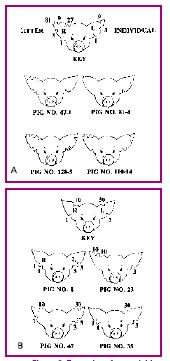

In some pork producing operations, it is important that piglets be permanently identified at birth. Options for permanent identification included ear notching or tattooing. Ear notching is the more common method. Each piglet must have a unique ear notch or tattoo in seedstock herds because it is a requirement for pedigree and performance records. It is not necessary that each piglet take an individual number in operations where all hogs except replacement gilts are marketed for slaughter. Each litter, or all piglets in a farrowing grouping, or only gilts to be considered for replacements might be ear notched or tattooed at birth with the aforementioned patterns.
The most mutual ear notching system is shown in Figure 8. It is the identification system required by the purebred swine associations in the U.S. The litter number is notched in the piglet's right ear and the individual piglet number in the piglet's left ear. Several modifications of the system exist.
Use a V-ear notcher designed for piglets to ear notch. Some producers use a hole puncher to place a hole in ane ear for identification. Firmly concur the ear you are notching and place the portion of the ear you are notching well dorsum into the jaws of the notcher (Figure ix). Notches that are too shallow may fill in, heal over, and be difficult to read. Leave at least i-fourth inch betwixt notches. Do non make notches as well close to the tip of the ear, as these can be torn off. When you lot have notches on both top and bottom of the ear near the tip, position them and then that the deep points of the notches are outset from each other. When making notches on top of the ear shut to the head, uncurl the ear with your fingers then y'all can make it deep into the cartilage. Otherwise, information technology might be unreadable afterward it heals.
Utilize tattooing pliers designed for small animals to tattoo piglets. Utilize the tattoo to the backside of the ear so it can exist read easily every bit the piglet grows. Exist sure to apply even pressure across the entire tattoo expanse (i.eastward., avoid the cartilage ribs in the ear). Avoid tattooing piglets with color on their ears, because the tattoo will be hard to read. Green ink seems to piece of work the all-time.
Supplemental Nutrients
Many liveborn piglets die because they starve. Disadvantaged piglets are most affected because they cannot compete well for milk and they are nigh vulnerable to chilling. Producers can improve their survival rate by giving a supplemental source of nutrients the first few hours of life.
Provide disadvantaged piglets with 10 to fifteen ml of milk every six to 12 hours during the first twenty-four hour period or ii following farrowing. The economic do good of providing supplemental milk to piglets depends primarily on the preweaning survival rate of piglets in the herd and on the anticipated profit from the piglet. In general, if the boilerplate preweaning survival rate of piglets in the herd is over 90% and the market value of the piglets is low, the cost of the actress labor to feed the modest ones may not be recovered.
It is critical that the first dose be colostrum, specially if the piglet has non suckled. Colostrum from the dam is best, only obtaining it is fourth dimension consuming. Commercial milk replacers have proven effective after the piglets receive an adequate dose of colostrum. Some people use products containing medium concatenation fat acids (MCT) in lieu of milk, simply research results on their effectiveness are mixed. Use a stomach tube or a syringe to requite the supplemental milk to the piglets.
Splaylegged Piglets
Splaylegged piglets announced to exist normal except when they attempt to stand, their hind legs (and sometimes front legs) extend sideways. The status appears to be a congenital disease with a higher incidence in litters with a 113 day or shorter gestation period. Also, a glace floor in the farrowing quarters tin be an important predisposing factor. Nutrition does not appear to play a part. The mortality rate in piglets where only the back legs are splayed can exist reduced by taping the legs soon later on nativity to prevent them from extending sideways. Piglets that are splayed in both their front and dorsum legs often are not worth trying to salvage. Consider euthanizing them.
Use either elastic wrapping tape, adhesive tape, or duct record. Obtain elastic tape from medical supply stores or veterinary offices and agglutinative tape from sporting goods store or pharmacies. Cut the tape in ½ to 3/iv inch strips. Apply tape to the rear legs allowing a two-inch gap between legs so the piglet can stand properly. Avoid wrapping the tape as well tightly as to restrict apportionment of blood and be sure to remove the tape a few days later.
Castration
Castration, the surgical removal of the two testicles, is a routine management practice for male piglets destined for slaughter. The testicles produce sperm and the male person hormone, testosterone. Pork from boars, or uncastrated male person piglets at slaughter weight, may have an odour during cooking that is very offensive to many people. This is chosen a "boar odor" or a "boar taint".
There are various ways to castrate piglets. The position of the animal during surgery and the method and degree of restraint are dictated by the historic period and size of the animal. The best time to castrate a piglet is when it is four to 14 days of historic period. Young piglets are easier to hold or restrain, bleed less from surgery, and have antibiotic protection from the sow's colostrum and milk. Piglets can be successfully castrated when they are less than iv days old; all the same, one of the major disadvantages of castrating very immature piglets is that scrotal hernias are more difficult to detect and the testicles may not have descended.
Examine each piglet advisedly before castrating to identify those with a scrotal hernia. A piglet with a scrotal hernia has a loop of intestine in its scrotum. Hold the piglet upright and then the scrotum is down to see if the scrotum is uniform in size, or hold the piglet with its caput down and squeeze the back legs together to lift the testicles. If at that place is an enlargement in i or both halves of the scrotum, the piglet probably has a hernia. Practice not castrate the piglet unless you lot are trained to repair hernias. The piglet's intestines will be forced through the incision. Sometimes the testicle is removed before a scrotal hernia is discovered. If this happens, the herniation must be repaired past suturing immediately. Most scrotal hernias are genetic in origin. Exercise not go along replacement animals from whatever litter in which one or more than piglets was herniated.
If one or both testicles are not constitute, the piglet may be a cryptorchid. This means that the testicle(s) failed to descend through the inguinal canal from the abdomen during development. When this status is noticed, ear notch or mark the piglet and brand a record of it. Often, the testicle(s) will descend to a normal position as the piglet grows. The piglet should be castrated after the testicle presents itself. If one testicle has descended at the time of castration, it should exist removed. Use either a surgical pocketknife or side cutter to castrate. The surgical pocketknife can be either a #12 hooked blade or direct blade. The instrument of choice must exist sharp and disinfected. If the scrotum is dirty, clean information technology and surrounding surface area with a cotton swab soaked in a mild disinfectant.
Castration Methods for I Person Using a Knif
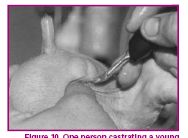
Hold the piglet by both hind legs with its head downwardly. Push button up on both testicles and make an incision through the skin toward the tail (Figure 10). Be sure to cut low in the scrotal sac to ensure practiced drainage. It does non matter if you lot cut through the white membrane or not. Pop the testicles through the incision and pull on them slightly. Pull each testicle out pressing your thumb against the pelvis of the piglet. Use of your thumb is very important to ensure the cord will break off at the point of your pollex and non from deeper inside the piglet's body. Otherwise, yous may cause a hernia.
Alternatively, identify the piglet's head between your legs subsequently y'all have made the incisions equally described above, grab each testicle and cut the cord close to the incision with a scraping movement. As well, cut whatever string or tissue protruding from the incision and spray the wound with an antiseptic.
Castration Method for One Person Using Side Cutters
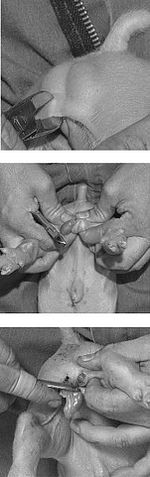
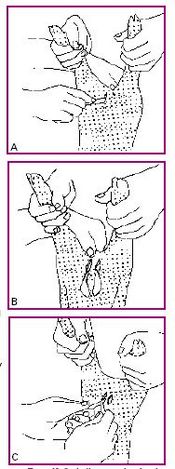
This technique is best performed on piglets between iv and ten days of age. There is lilliputian or no bleeding with this method. Concur the piglet betwixt your legs with the belly outward. Utilize your index finger, or whichever is comfy to use, to push button upward on ane testicle to make it more pronounced. The resulting fold of skin is where the incision is fabricated (Figure 11a). Position disinfected side cutters nigh two thirds of the style into the fold and make a cut directly through the scrotal tissue (right of the midline). Make a similar incision through the scrotal tissue, but to the left of the midline. Popular the testicles out through the incisions by pinching your thumb and alphabetize finger together (Effigy 11b).
Press very firmly with your index finger against the pelvis of the piglet in front of the scrotum and pull the testicles out with the side cutters (Figure 11c). Employ of your alphabetize finger is very important to ensure the string will break off at the point of your index finger and not from deeper within the piglet's body. Otherwise, you lot may cause a hernia. Care is taken to avoid cutting through the cords beneath the testicle. Remove any loose cord tissue left outside the incision. Nothing but the disinfected side cutters touches the exposed tissue. Spray the wound with an antiseptic.
Castration Method for Two People Using a Knife
One person holds the piglet by the rear legs while another does the castrating. With one mitt, tighten the peel over the scrotum to assistance expose the testicle and the site for the incision. With the castration knife, make two incisions near as long as the testicles near the centre of each (Figure 12a ). Cutting securely enough to go through the outside torso skin. It does not matter whether you lot cutting through the white membrane (tunica vaginalis), which surrounds the testicle, or not. Squeeze, or popular, the testicles through the incision (Figure 12b ). Enlarge the incision slightly at the finish closest to the tail if the testicle will not popular out.
Pull out the terminate of the testicle which is toward the tail at a right angle to the length of the body and cut the cord close to the incision (Figure 12c). Practise non pull straight up on the testicle. Repeat the procedure for the second testicle. Spray the wound with an antiseptic.
Postal service-Castration Intendance
Find castrated animals for excess bleeding or the presence of tissue or intestines (hernia). Employ pressure to the wound for about ii minutes to stop whatever bleeding. Cut off any string that may be protruding from the incision every bit this may serve as a wick for infection, merely make certain it is non intestine.
If intestines beetle and they are black or torn, information technology is usually all-time to euthanize the piglet. If the problem was recognized promptly afterwards the intestines came out, information technology is possible to save the piglet. First, gently make clean the intestines with clean, warm h2o containing a surgical disinfectant, and push them back through the opening holding the piglet's caput down by its rear legs. Close up by suturing the tunica vaginalis (white membrane which surrounds the testicle). If a skilled professional person is not available to suture the tunica vaginalis, just suture the castration incision closed to allow time for a skilled surgeon to repair the hernia properly a few hours afterwards. If a skilled surgeon is not bachelor in a few hours, the piglet should be euthanized. It is much easier to supplant the intestines if the tunica vaginalis roofing the testicle is not removed during castration. Administer an antibiotic afterward surgery.
Equipment Intendance
Proper equipment care will help ensure that piglets will be processed with minimal discomfort and complications from infection. Subsequently each use, identify equipment such equally side cutters and ear notchers in a basin of nonirritating disinfectant. Do this rather than laying equipment on the cart or platform after they accept been used to process each piglet. Modify the disinfectant after most every ten litters. Before moving to another farrowing room to procedure, clean and disinfect the cart and equipment. Also, bank check needles to ensure they are not bent or blunt on the end. Supervene upon needles after they have been used on 30-fifty piglets or earlier if damaged. Dispose of needles in a sharps container.
Weighing
Pork producers who use birth weights as function of their management system can incorporate the weighing into the piglet processing routine. Most piglets are non weighed at nascency, but if they are, this should be done first, followed by the rest of the processing. Some producers weigh each piglet and record the sex and weight. Others identify the entire litter on the scales and record total litter weight.
Records
We recommend pork producers use production records to place strengths and weaknesses in the operation. If problems are experienced in the farrowing quarters, these problems will go on to propagate if accurate records are not kept. It is important to realize that reproductive traits are heritable. Record keeping allows superior sows to be identified and retained on the farm. This will lead to successive improvements in lactational performance which should atomic number 82 to fewer issues in the farrowing quarters. In addition, accurate records provide an of import view of the animal caretaker's job performance. Records help management identify people who are doing a good chore (which may be rewarded) and they help identify weak areas that the flagman can work to better.
Records kept in the farrowing quarters include: nativity date, number of piglets born live and expressionless, date and crusade of expiry of piglets, pedigree data, number of piglets weaned, and piglet (or litter) weaning weight. Remarks on anything unusual or wrong with the piglet should be noted as well. In addition, many producers are recording feed intake during lactation. Medications given to animals should exist recorded to ensure handling protocols and withdrawal periods are followed.
Have cards, clipboards, or other recording devices nigh each farrowing crate or pen. Having the opportunity to tape information the moment it is collected or observed ensures accurateness. Always have a pencil or pen in your pocket and besides with the equipment used to procedure piglets. Record data in ink whenever possible and applied. This makes the forms easier to read and ink as well withstands the surroundings of the farrowing quarters better. Also, record data in legible handwriting and make it a habit to write your initials beside the entry if more than one person routinely works in the farrowing quarters.
Daily Piglet Observation
Closely observe each piglet at least twice daily for evidence of adequate milk product by the sow. Careful observation of piglet behavior and body condition is the best method of determining if a sow is milking well. Lactation failure must be treated aggressively and the litter may need to exist given supplemental milk every bit the sow is recovering.
Healthy, well-nourished piglets run effectually and play, peculiarly when the sow rises to eat. For the commencement few days of their lives, piglets do fiddling more than eat and sleep. Withal, in a few days they brainstorm to be active abroad from the udder. These activities are delayed in piglets that are ill or undernourished. Subsequently a successful nursing, piglets volition ofttimes settle downwards and sleep. Milk is oft seen around their mouths.
In the normal sow, milk ejection from the teats starts almost 1 to three minutes following initiation of nursing behavior (which occurs about in one case each hr in early lactation). And then oxytocin is released and milk letdown occurs. The piglets will nurse steadily for about 30 seconds then gradually quit. Piglets nursing a sow with lactation failure will spend more than time at the udder, including fighting, and will exist less content. If the piglets' needle teeth have non been clipped, they can inflict severe damage to the faces and snouts of litter mates and sometimes to the sow'due south udder.
Well-nourished piglets have tight, shiny skin and a thrifty look, i.e., "bloom". Piglets go from having less than i% body fatty at nascence to about 10% by 10 days of age. Much of that fatty is stored just under the skin. Information technology is that rapid accumulation of subcutaneous fat that gives piglets tight, shiny skin and a thrifty look. Piglets that are not performing well, have loose peel, expect depressed, and accept a "hairy" appearance.
Preventing Piglets' Exposure to Diseases
Preventing piglets from encountering disease agents (chief prevention) involves five basic areas: (1) source and handling of primary and replacement breeding stock, (two) rules governing movement of people, vehicles, materials, and pigs, (3) layout of the farm, (iv) location of a new farm, and (5) cleaning the farrowing quarters and the sow.
We recommend producers divert more resources to primary and secondary prevention techniques. Less accent should be placed on the less constructive and more costly approach of using drugs and biologics to treat sick piglets. How much to divert and the response to expect will depend on the current condition of the herd. A tape program that can store the necessary information and allow data retrieval in a usable format is the basis of an effective wellness programme.
Baby Hog Infectious Diseases and Treatment Protocols
The most important aspects of maintaining the wellness of piglets is to ensure they receive as much colostrum as possible and that they have a warm, draft-gratuitous environment. Regardless, piglets will die of illness and the causes tin can be broadly classified as those occurring regularly (owned) or just occasionally (epidemic). Although the causes volition vary by subcontract, the typical endemic disease will cause problems continually and contribute to a low-level "normal" neonatal mortality of v-15%. Colibacillosis and Coccidiosis are ofttimes owned diseases. In contrast, a illness such as Transmissable Gastroenteritis can cause an epidemic of neonatal losses up to 100% and last for many weeks.
Diagnosis. Determining the cause of neonatal hog losses is not like shooting fish in a barrel because few diseases produce signs that are unique to the causative agent. For case, baby pig scours tin be caused past a leaner, virus, or parasite and you lot cannot distinguish between them by the nature of the scours. Your veterinarian tin can assist you in obtaining a diagnosis and recommending handling. Information technology'south expensive and wasteful to brainstorm treating if yous're unsure of the cause of the disease and so it is important to obtain a diagnosis and treat appropriately. For the experienced observer, some diseases which occur regularly on the farm can exist recognized by subcontract managers and handling instituted as soon as the signs are recognized. However, if the piglets do non reply to treatment, then contact your veterinarian to reassess the situation and check the diagnosis.
Treatment. Appropriate handling will vary depending on the cause of the disease. Provided the organisms are sensitive, antibiotics volition unremarkably alleviate a bacterial infection; however, antibiotics will not affect viruses or parasites. Sometimes antibiotics are recommended to help prevent secondary infection when the primary infection is a virus or parasite. In these cases, the antibiotics do not bear upon the organism causing the affliction, they just aid ensure that bacteria do not accept advantage of the weakened piglet. Treatments for individual diseases are discussed below. Remember that all drugs must exist administered according to label directions unless your veterinarian has directed you to practise otherwise.
Commonly Seen in Unweaned Piglets (Listed Alphabetically)
Clostridial Infections. The disease is caused when Clostridium perfringens, which is a normal inhabitant in the large intestine, becomes established in the minor intestine. This normally occurs when the piglet has had insufficient intake of colostrum. Its severity will vary dependent on the type, A, B, or C (the most astringent), but piglets usually develop a foul smelling diarrhea and many will die. It is more than commonly seen in piglets less than seven days onetime. Antitoxins can be injected into sows and piglets and oral ampicillin is commonly recommended.
Congenital Tremor. About pork producers have seen newborn pigs with tremors and shaking muscles. It tends to come and go sporadically but seems to be more common in gold herds, where 80% of litters tin can have affected piglets. The affliction is associated with infections with Pseudorabies virus, Japanese Encephalomyelitis virus, Classical Swine Fever (Hog Cholera) and Circovirus. It is also associated with hereditary illness in Landrace and Saddleback breeds or with organophosphate poisoning. Affected piglets must be assisted to suckle and provided for until they abound out of the disease in a few weeks.
Greasy Pig Disease. (Exudative Dermatitis). Greasy pig illness is often a problem in newly established golden herds. The causative bacterium, Staphylococcus hyicus, infects the skin of a piglet and produces a toxin that damages its liver and kidneys. A piglet is commonly infected at, or soon subsequently, birth. Lacerations on the side of the face up, made by unclipped needle-teeth equally piglets scramble for the all-time teat on the sows' udders, are thought to be the site where the bacterium often showtime infects the piglet. The first clinical signs appear between four to 35 days when small night spots appear on the side of the face. Then, dark-brown scales develop on the underside of the piglet which, in serious cases, spread to comprehend the whole piglet. Severely affected piglets unremarkably dice and survivors do poorly. Afflicted herds tin endure decreased growth operation for 12 months. The disease is readily recognized by its typical appearance, and treatment is virtually successful when started as shortly as signs appear. Before antibiotic treatment is started, affected alive piglets should be submitted to a laboratory to make up one's mind the antibiotic sensitivity of Staphylococcus hyicus Greasy squealer illness is difficult to control unless mange is first eliminated. The mange mites damage the skin and allow Staphylococcus hyicus to enter. Affected piglets should be given electrolytes orally because they become dehydrated rapidly. Some farms experiencing severe outbreaks have had success using an autogenous vaccine. The illness tin can exist prevented by removing any sharp edges in the farrowing crate that may lacerate the piglets, cutting needle teeth, spraying the udder of the sow with an iodine based disinfectant, adopt an all-in/all out policy for the farrowing firm and ensure the room is thoroughly disinfected and dry before sows enter.
Sometimes Seen in Unweaned Piglets
Eperythrozoonosis. (Epe). Epe is a difficult disease to both understand and care for. The causative rickettsial organism, Eperythrozoon suis, is nowadays in the claret of sows in both healthy and diseased herds. In some piglets, it attaches itself to red blood cells and destroys them causing anemia. Affected piglets are weak, pale, and jaundiced, have scours and pneumonia, and suffer high bloodshed. Before attempting to care for for Epe, information technology is very important to have your veterinary confirm the diagnosis. The response to drug treatment is poor and, at the time of writing, the Food and Drug Administration (FDA) has not approved any drug for treating Epe. Eperythrozoon suis is spread by infected blood so, when attempting to control an epidemic, information technology is very of import to clean and disinfect instruments betwixt piglets when processing. Annihilation that can outcome in blood beingness transferred between piglets must exist controlled including parasites, fighting, tagging, and injections.
Glasser'southward Disease. Glasser's Disease is caused by Hemophilus parasuis which is present in most herds. It has go more than important in recent years with piglet mortality sometimes exceeding 50% in high-health condition herds. The affliction usually affects weaned pigs, only suckling piglets can be affected. Often the heaviest, all-time looking, piglets die. Pigs are fevered, depressed, boring to rise, lack appetite, and accept bloated joints. Some have nervous signs such as tremors. Before they die, the pare often turns blueish and the eyes are reddened. The organism is difficult to grow so diagnosis is unremarkably fabricated solely on clinical signs and postmortem findings. Hemophilus parasuis is sensitive to a broad range of antibiotics including the penicillins, tetracyclines, and ceftiofur. It is best to start handling as early as possible and a combination of injectable and water medication is usually indicated. In problem herds, autogenous vaccines can exist useful.
Parasites. (See PIH-05-04-01)
Porcine Reproductive and Respiratory Syndrome (PRRS). PRRS is usually only seen in unweaned piglets when the disease first infects a naive herd. Piglets may coughing, sneeze, and have diarrhea, conjunctivitis, and difficulty breathing. Signs in individual herds will vary because of the effects of different secondary infections. Individual piglets should be rehydrated and treated with antibiotics to control secondary infections. A herd control program should be formulated in conjunction with the attention veterinary.
Tetanus. Tetanus is rare in piglets only sometimes the causative bacterium, Clostridium tetani, will infect piglets when they are castrated. Because the incubation period is 1-10 weeks, signs are rarely seen until the pigs are at least two weeks old. Affected piglets are stiff, have an erect tail, and facial musculus spasms. For problem herds, an constructive vaccine is available. Managers should review castration and other processing procedures to ensure they are using hygienic techniques.
Rarely Seen in Unweaned Piglets
The diseases mentioned in a higher place are the main ones found in suckling piglets. Other diseases may rarely occur—when they do, it is usually associated with overwhelming infection in a naive herd. Those disease include: Mange, Mycoplasma pneumonia, Actinobacillosis suis, Brucellosis, Erysipelas, Leptospirosis, Parvovirus, and Influenza.
Methods of Euthanasia for Babe Pigs
Euthanizing animals is an unpleasant but necessary part of livestock farming. Producers often have to euthanize piglets because they are sick and suffering with little-or-no hazard of recovery. Some piglets should be euthanized because if left to live they become a source of infection for their pen or littermates. This situation is particularly important in the Porcine Reproductive and Respiratory Syndrome (PRRS) era when removing the poor-doing, PRRS- virus-carrying piglets is an important part of controlling the affliction. In these and other similar situations, euthanasia is the humane and responsible solution.
Piglets should be euthanized by exposure to carbon dioxide or edgeless mechanical trauma to the head. Electrocution is acceptable but it can be a human wellness rubber hazard, and piglets must be candy 1 at a fourth dimension making information technology very fourth dimension consuming. Controlled drugs (e.g., barbiturates) are very effective just present major human wellness risks and should exist used only past veterinarians.
Carbon Dioxide
Obtain a cylinder of carbon dioxide, a regulator, a 50-gallon trash tin and a supply of plastic trash bags to fit the can. Take a trash purse and blow information technology upwards, like a balloon, with the carbon dioxide. This ensures that the handbag is total of carbon dioxide. Identify the bag in the trash tin, add upward to vi piglets, and close the bag. The piglets volition exhibit a physiologically induced short catamenia of musculus spasms as they chop-chop die from respiratory arrest. Leave the piglets for at to the lowest degree 15 minutes, and so open the handbag and check each piglet to ensure that it has died before disposing of it unremarkably. Your veterinary can evidence you how to bank check for a heart crush and the corneal reflex.
Blunt Mechanical Trauma
Place the piglet on the footing and apply a quick, house blow with a blunt instrument, such as a hammer, to the piglet'southward head. The point to aim for is where two imaginary lines, drawn from the base of each ear to the reverse heart, cross. Alternatively, hold the piglet by its hind legs and forcefully hitting the piglet'south head against a difficult surface such equally concrete. Immediately repeat the above procedures procedures if there is whatsoever possibility that the animal is still alive.
Farm managers need to be sensitive to the disfavor many people have to euthanizing animals and ensure they assign the task to someone who is comfortable with the task. Many people inbound the pork manufacture nowadays do not accept a farming background and are not accustomed to routine farming practices. If people are not comfy with the job and they find no relief, their feelings tin upshot in absenteeism, belligerence, or devil-may-care and callous handling of animals, and high staff turnover.
Reference: On farm euthanasia of swine—Options for the producer. AASP and NPPC booklet.
Pitter-patter Feeding
Creep feeding is recommended beginning at near 10 days of historic period for piglets weaned at 3 weeks of age and after. Sow milk yield typically plateaus at near 12-xvi days of lactation indicating that sufficient nutrients will not be available thereafter to sustain maximal piglet growth. For piglets weaned at less than three weeks of age, the value of pitter-patter feed is questionable, because they often consume very little feed. If pitter-patter feed is offered, use techniques to ensure piglets eat the feed.
Some direction techniques that assistance improve creep feed intake are below.
- Use the proper nutrition. The complexity of the diet is a big factor affecting success of creep feeding. Piglets will consume more than of a diet that has several speciality ingredients (east.yard., plasma proteins, whey, etc.) than a simpler i. A feed provided in a mini-pellet form is preferred likewise. Therefore, employ a diet especially made for creep feeding.
- Accept fresh water available. Piglets that take access to fresh water eat more feed than those who don't. Special nipple waterers are available for piglets.
- Go along the feed fresh. Piglets must be attracted to the feed, which means feed cannot smell like the surroundings. Offer limited amounts of feed to the piglets several times daily and store the feed in a facility or room separate from pigs. Remove dried or uneaten feed from the farrowing quarters daily.
- Make the feed easily accessible. When introducing creep feed, sprinkle small quantities on the flooring or in a shallow pan.
Split Weaning
Where piglet menses management allows it, split weaning is a technique that tin can give slower growing piglets a boost simply earlier weaning. The process involves weaning the heavier piglets in a litter a few days earlier weaning the smaller ones. This allows smaller piglets access to a larger milk supply with less competition. To ensure that smaller piglets in the litter will benefit from split weaning, wean the heaviest piglets iii to five days early.
This technique may shorten the weaning-to-estrus interval in sows, especially in those left with simply a few piglets for the final couple days of lactation. This may alter breeding schedules slightly.
Figure 1. How to concur a piglet Figure two. A foursquare knot; B. surgeon's knot.
Figure three. Clipping the navel cord.
Effigy 4. Clipping the needle teeth.
Figure 5. Clipping the needle teeth.
Figure 6. Docking the tail. Leave nigh a 1-inch stump.
Effigy 7. Injecting fe into the neck muscle.
Figure 8. Examples of ear-notching numbering systems: A. Universal ear-notching system using litter and individual pig numbers; B. Using individual pig numbers.
Figure 9. Notching the left ear.
Figure 10. One person castrating a young grunter.
Figure 11. Castration using sidecutters: A. Making the incision; B. Exposing the testicles; C. Removing the testicles.
Figure 12. Castration procedure for pigs several weeks erstwhile: A. Making the incision; B. Squeezing out the testicles; C. Cutting the cord.
Source: https://swine.extension.org/baby-pig-management-birth-to-weaning/

Post a Comment for "How Long Should It Take to Wean Baby Piglets"